
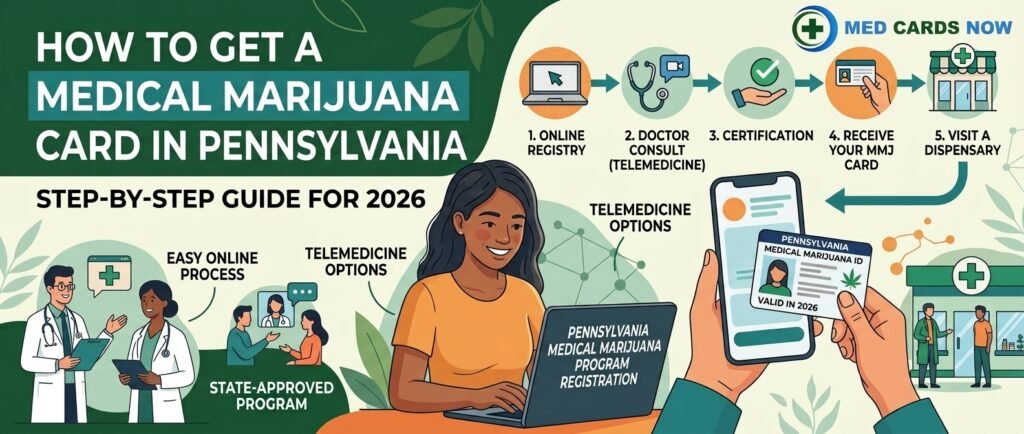
If you are researching how to get a medical marijuana card in Pennsylvania, the process is more straightforward than it may first appear. Pennsylvania operates a state-run Medical Marijuana Program through the Department of Health, and patients generally move through a sequence of registration, practitioner certification, card payment, and dispensary access. The important part is understanding that simply having a health condition does not automatically produce a card. You must be a Pennsylvania resident, have an eligible serious medical condition, and receive certification from a practitioner approved to participate in the program.
For 2026, the Pennsylvania process is largely digital, which means you can complete much of the preparation online before visiting a dispensary. You will need a valid Pennsylvania driver’s license or Pennsylvania-issued identification card, a working email address, and a patient account in the state’s registry. After registration, an approved practitioner evaluates whether you have an eligible condition and whether you are likely to receive therapeutic or palliative benefit from medical marijuana.
This guide walks through the Pennsylvania medical marijuana card process step by step, including eligibility, qualifying conditions, registration, doctor certification, costs, renewals, caregivers, telemedicine, dispensary access, and common mistakes. The goal is to give you a practical 2026 roadmap so you know what happens before, during, and after your certification.
What Is the Pennsylvania Medical Marijuana Program?
The Pennsylvania Medical Marijuana Program is the state’s regulated system for providing medical marijuana access to residents who have an approved serious medical condition and have been certified by an approved practitioner. The program was established under Pennsylvania’s Medical Marijuana Act and is administered by the Pennsylvania Department of Health. The state maintains patient and practitioner registries and regulates the pathway from certification to dispensing.
Think of the program like a secure chain with several links. Your Pennsylvania residency establishes that you belong in the state’s system, your medical condition establishes potential eligibility, an approved practitioner provides the required certification, and the state registry connects that certification to your medical marijuana ID card. Only after those pieces are properly connected can you use the card to obtain medical marijuana from a Pennsylvania dispensary. The process is designed this way because Pennsylvania does not treat a medical marijuana card as an ordinary retail membership card. It is part of a regulated healthcare and identification system.
The Department of Health describes the patient process as registration, practitioner certification, payment for the medical marijuana ID card, and then dispensary access. That sequence removes much of the confusion surrounding online advertisements and third-party services. If you want a broader explanation of how an online medical card process works, Med Cards Now also has a dedicated How It Works resource.
Who Can Participate in the Program?
A person generally needs to satisfy three core requirements to participate as a Pennsylvania medical marijuana patient. First, the person must be a Pennsylvania resident. Second, the person must have an approved serious medical condition. Third, an approved practitioner must certify the patient through the Pennsylvania Medical Marijuana Program.
Pennsylvania allows both adults and minors to participate when the program requirements are satisfied, although minors have additional caregiver requirements. The state also provides pathways for homebound patients and patients who need assistance, allowing caregivers to handle dispensary access in qualifying circumstances. This matters because the process is not identical for every patient.
Pennsylvania Medical Marijuana Card Requirements
The core medical marijuana card Pennsylvania requirements are centered on residency, an eligible serious medical condition, practitioner certification, and registration with the state. You should have a valid Pennsylvania driver’s license or Pennsylvania state-issued identification card available because the Department of Health uses that information during registration. You also need a working email address because the registry uses email communication to confirm registration and provide important instructions.
Your name and other information should be entered carefully and consistently. The Department of Health advises patients to have their Pennsylvania identification document in front of them while registering and to enter their first and last names exactly as they appear on the identification. Your current mailing address should also be entered accurately. Small data-entry problems can become surprisingly large roadblocks, so spending an extra few minutes checking your information before submitting the registration can save time later.
Pennsylvania Residency and Identification
Residency is not a minor detail in Pennsylvania’s program. Patients must be Pennsylvania residents, and the state expects patients to provide a Pennsylvania driver’s license or Pennsylvania-issued identification card during registration. If your identification is expired or your information does not validate correctly, the registration system can become difficult to complete.
Having your identification document beside you while completing the online registration is one of the easiest ways to reduce mistakes. You should also have access to the email account you plan to use for your registry account because you will receive confirmation and subsequent program instructions electronically.
Qualifying Medical Conditions
Pennsylvania recognizes a defined list of serious medical conditions for the Medical Marijuana Program. The state’s list includes conditions such as anxiety disorders, autism, cancer including remission therapy, Crohn’s disease, epilepsy, glaucoma, HIV/AIDS, multiple sclerosis, neuropathies, Parkinson’s disease, post-traumatic stress disorder, sickle cell anemia, terminal illness, Tourette syndrome, and severe chronic or intractable pain, along with other qualifying conditions.
The wording of a qualifying condition matters. For example, Pennsylvania’s approved category for severe chronic or intractable pain includes specific language, while opioid use disorder has conditions concerning conventional therapeutic interventions. Therefore, it is better to compare your situation with the state’s current eligibility language rather than relying on a simplified list found on a commercial website. You can also review Med Cards Now’s medical cannabis information for anxiety or its chronic pain resource for general educational information, while the final eligibility decision remains with an authorized practitioner.
Step 1: Register With the Pennsylvania Patient Registry
The first practical step toward getting a Pennsylvania medical marijuana card is creating your patient account through the state’s Medical Marijuana Program registry. You should register before your practitioner consultation because Pennsylvania’s guidance says patients should have their patient ID number available when seeing the practitioner. Registration establishes your account and gives the practitioner the information needed to connect the certification to your patient profile.
During registration, carefully enter your identifying information, mailing address, contact information, and other requested details. After your information is validated, you create a username and password, and the system provides a Patient ID number. You will also receive an email confirming successful registration and explaining the next step. Treat this email as important rather than as routine inbox clutter because it can tell you what needs to happen next.
Information You Need Before Registering
Before opening the registration form, gather your Pennsylvania driver’s license or state-issued ID and make sure it is current. Have access to a working email address and make sure you can receive messages from the state’s system. It is also useful to have your current mailing address written exactly as you normally receive official mail because the registry may validate the address against USPS information.
Take your time with the form. A rushed registration can create avoidable problems if your name, date of birth, identification number, telephone number, or address is entered incorrectly. If the system does not validate your information, check that your identification is not due for renewal and that numerical fields contain only the required digits.
Step 2: Find a Pennsylvania-Approved Practitioner
Once you have registered and obtained your patient ID, the next step is to see a practitioner approved to participate in Pennsylvania’s Medical Marijuana Program. This is a critical distinction because not every doctor automatically has authority to certify patients for the program. The practitioner must be registered with Pennsylvania’s program and must complete the required certification process through the state’s system.
During the consultation, the practitioner evaluates your health information and determines whether you have an eligible serious medical condition and whether medical marijuana may provide therapeutic or palliative benefit. The consultation is not simply a box that gets checked because you requested a card. It is part of the practitioner’s clinical and regulatory determination.
You should be prepared to discuss your medical history honestly and provide relevant health information when requested. If you have records related to the condition you are seeking certification for, having them available may make the consultation more useful. The exact documentation a practitioner requests can vary, so follow the practitioner’s instructions rather than assuming every patient needs the same paperwork.
Step 3: Complete Your Medical Evaluation
The medical evaluation is the point where eligibility becomes a practitioner decision rather than simply a checklist. The practitioner must determine that you have an eligible serious medical condition, are under the practitioner’s continuing care, and are likely to receive therapeutic or palliative benefit from medical marijuana.
A good consultation should give the practitioner enough information to understand your situation. Be prepared to discuss your diagnosis, symptoms, current treatment, relevant medical history, and other information requested during the evaluation. Avoid exaggerating symptoms or presenting information that is not medically accurate simply because you believe it will improve your chances of certification. The purpose of the consultation is to establish whether the legal and clinical requirements are satisfied, not to manufacture eligibility.
Can Pennsylvania Doctors Certify Patients Through Telemedicine?
Yes. Pennsylvania permits participating practitioners to issue certifications through synchronous interaction, including telephone or video conference, when the applicable requirements are met. This means eligible patients may be able to complete the practitioner consultation remotely when the practitioner offers telemedicine. For a general overview of the online process, the Med Cards Now How It Works page explains the basic flow from an online form to a provider evaluation.
Telemedicine can make the process more convenient, especially for people who have difficulty traveling. However, it does not remove the underlying eligibility requirements. You still need to register with the Pennsylvania program, have an eligible condition, and complete the required practitioner consultation. A video appointment is simply a different method for conducting the interaction, not a shortcut around Pennsylvania’s certification rules.
Step 4: Receive Your Patient Certification
If the approved practitioner determines that you meet the program requirements, the practitioner enters the certification into Pennsylvania’s system. The state then sends the patient an email explaining the next steps for obtaining the medical marijuana ID card.
The certification period is determined by the practitioner but cannot exceed one year. This is important because certification and card validity are related but are not exactly the same concept. You should keep track of your certification and registration dates so you are not caught by surprise when renewal becomes necessary.
There is also a timing issue after certification. Pennsylvania states that if the required card payment is not made within the applicable state timeframe, the certification can expire and a new certification may be required. Once certification is entered, completing the remaining steps promptly is therefore a sensible approach.
Step 5: Pay for Your Pennsylvania Medical Marijuana ID Card
After certification, you can return to your Pennsylvania registry account and use the payment section to pay for your medical marijuana ID card. The Pennsylvania Department of Health currently lists the patient or caregiver medical marijuana ID-card fee as $119. Some individuals participating in eligible government assistance programs may qualify for a no-cost card.
The payment stage is one reason it is useful to complete your registration correctly from the beginning. You cannot simply pay for the card before the required first-time certification is entered into the system. Pennsylvania states that first-time patients must have practitioner certification before they become eligible to make the payment.
Card Fees and Potential Financial Assistance
The standard patient or caregiver medical marijuana ID-card fee is currently $119 according to Pennsylvania’s Department of Health. Eligible participants in programs including Medicaid, PACE/PACENET, CHIP, SNAP, and WIC may qualify for a no-cost medical marijuana ID card. The practitioner consultation is separate and may involve an additional fee that is not covered by insurance.
| Cost item | What to know in 2026 |
| Pennsylvania medical marijuana ID card | $119 standard state fee |
| Practitioner consultation | Separate cost; varies by practitioner |
| Eligible assistance programs | Some patients may qualify for a no-cost ID card |
| First replacement card | $25 |
| Additional replacement cards | $119 each |
Step 6: Receive Your Medical Marijuana Card
Once you have completed the required steps and paid the card fee, Pennsylvania prints and mails the medical marijuana ID card. The Department of Health advises patients to allow time for printing and delivery, so you should not assume the physical card will appear immediately after payment.
That means you should plan around the state’s stated processing and mailing time rather than booking your schedule around an assumption that the card will arrive in a day or two. Keeping your mailing address current in the patient profile is also important because the card is mailed to the address listed there.
Step 7: Visit a Pennsylvania Medical Marijuana Dispensary
After receiving your medical marijuana ID card, you can visit an approved Pennsylvania dispensary. The Department of Health maintains information about dispensaries across the Commonwealth, and the program allows patients to purchase medical marijuana from Pennsylvania dispensaries once they have completed the required registration and certification process.
Bring the identification and documentation required by the dispensary. Your medical marijuana card is an important part of the process, and dispensaries may also have their own intake procedures for first-time patients. Some dispensaries require appointments for a first visit, so checking with the dispensary before traveling can prevent an unnecessary trip.
How Long Does It Take to Get a Medical Marijuana Card in Pennsylvania?
There is no single guaranteed total processing time because different parts of the process depend on your registration, practitioner appointment, certification, payment, and card mailing. The state provides benchmarks for the physical card, but the total experience can vary from patient to patient.
Your practitioner appointment may happen quickly or may require additional scheduling time depending on availability. If you are using telemedicine, the appointment may be easier to schedule, but availability still depends on the practitioner. You can make the process smoother by registering accurately, keeping your patient ID accessible, responding promptly to practitioner communications, and completing payment once certification is entered.
The most common delays are often simple administrative issues rather than mysterious problems. Incorrect identification information, address-validation errors, forgotten registry credentials, delayed practitioner appointments, and waiting too long to make the card payment can all interfere with a smooth application.
How to Renew a Pennsylvania Medical Marijuana Card
A Pennsylvania medical marijuana registration is not something you complete once and forget forever. Certifications have a defined period, and patients need to keep their registration active to continue participating in the program. The exact timing depends on your certification and registry status, so you should monitor the dates shown in your Pennsylvania account rather than relying on a generic reminder from a website or third-party service.
Renewal is easier when you start preparing before your existing authorization expires. Keep your contact information current, maintain access to your registry account, and arrange the required practitioner certification according to the state’s current process. Your practitioner may need to confirm that you continue to have an eligible condition and may need to determine that continued medical marijuana use is appropriate under the program requirements.
If you are researching online renewal options, the Med Cards Now Pennsylvania medical marijuana card page contains Pennsylvania-specific information about its available service and the general renewal workflow.
Caregivers and Pennsylvania Medical Marijuana Patients
Caregivers play an important role in Pennsylvania’s Medical Marijuana Program. A caregiver can obtain medical marijuana from a dispensary for a patient, which can be particularly important for minors, homebound patients, and patients who require assistance. Pennsylvania generally requires caregivers to satisfy separate registration requirements, including a criminal background check.
A patient can designate caregivers within the limits established by the program. Minors are required to have a caregiver, while certain adult patients may use caregivers because they are homebound or benefit from assistance. In these situations, the caregiver becomes the practical bridge between the patient and the dispensary.
Common Mistakes to Avoid When Applying
One of the most common mistakes is assuming that you should book a doctor first and register later. Pennsylvania’s process begins with patient registration, and patients should obtain their Patient ID number before seeing the approved practitioner. Starting with the registry gives the practitioner the information needed to complete the certification process properly.
Another mistake is entering information casually. Your name should match your Pennsylvania identification, your address should be current, and numerical fields should be entered in the format requested by the state. If something fails validation, repeatedly submitting the same incorrect information usually does not solve the underlying problem. Checking the document beside you and correcting the source information is a better first move.
Patients should also avoid assuming that every condition mentioned on a commercial website automatically qualifies. Pennsylvania’s official list is the appropriate reference, and some conditions have specific statutory or program language attached to them. The practitioner must ultimately make the certification decision within Pennsylvania’s requirements.
Finally, do not wait indefinitely after receiving certification. Once you receive the certification email and become eligible for payment, completing the remaining step promptly can prevent unnecessary re-certification.
Pennsylvania Medical Marijuana Card vs. Recreational Marijuana
Pennsylvania’s Medical Marijuana Program is a regulated medical-access system rather than a general recreational marijuana program. The state requires qualifying patients to register, obtain certification from an approved practitioner, and receive a medical marijuana ID card before obtaining medical marijuana through the program.
That distinction matters when searching online because websites sometimes mix information from different states. A guide written for a state with adult-use legalization may describe rules that do not apply in Pennsylvania. Age limits, possession rules, home cultivation, purchasing procedures, product formats, and identification requirements can vary significantly between jurisdictions.
For broader background on changing state rules, Med Cards Now maintains a Medical Marijuana Laws resource and a blog covering medical marijuana topics and state-specific guides. These resources can be useful starting points, but Pennsylvania’s official program should be checked for the latest legal requirements.
What to Know Before Visiting a Dispensary
Your first dispensary visit will be easier if you treat it as a healthcare-related retail visit rather than a normal shopping trip. Bring your medical marijuana ID card and the identification required by the dispensary, and check whether the location requires an appointment for first-time patients.
It is also sensible to review the dispensary’s current information before leaving home. Pennsylvania maintains a list of dispensaries, but individual dispensary operations can differ. Checking hours, first-visit requirements, available products, and payment information can prevent surprises when you arrive.
Patients should remember that having a medical marijuana card does not replace professional medical guidance. If you are already taking prescription medication or managing a significant medical condition, discuss relevant concerns with your healthcare professional. The practitioner who certifies you can also provide guidance appropriate to your individual medical circumstances.
Conclusion
Getting a medical marijuana card in Pennsylvania in 2026 involves a clear sequence: confirm that you meet the Pennsylvania residency and medical eligibility requirements, register with the state Medical Marijuana Program, obtain your Patient ID, complete a consultation with an approved practitioner, receive certification, pay the state card fee, and wait for the physical ID card to arrive. The Pennsylvania Department of Health currently lists a standard $119 patient ID-card fee, while certain government-assistance participants may qualify for a no-cost card.
The most useful strategy is to follow Pennsylvania’s official process in order instead of jumping between unrelated third-party websites. Keep your identification information accurate, watch your email after registration and certification, complete the required payment within the state’s timeframe, and keep track of your renewal dates. If you need a caregiver, understand that caregiver registration and background-check requirements are separate from patient registration.
Pennsylvania also permits participating practitioners to certify patients through synchronous telemedicine interactions, which can make the consultation stage more convenient for eligible patients. Still, telemedicine does not remove the need for state registration, an eligible medical condition, practitioner certification, or an active medical marijuana ID card.
The rules surrounding medical marijuana can evolve, so the safest source for current requirements is the Pennsylvania Department of Health. Before applying, renewing, or making decisions about specific products or program rules, check the state’s latest patient guidance and program announcements. That small habit can save you from following an outdated checklist and turning a straightforward process into a bureaucratic maze.
Frequently Asked Questions
1. How much does a medical marijuana card cost in Pennsylvania in 2026?
The Pennsylvania Department of Health currently lists the standard patient or caregiver medical marijuana ID-card fee as $119. Some people participating in qualifying government assistance programs may qualify for a no-cost card. The practitioner consultation is separate and may involve an additional fee that is not covered by insurance.
2. Can I get a Pennsylvania medical marijuana card online?
Much of the administrative process can be completed online, including patient registration. Pennsylvania also permits approved practitioners to issue certifications through synchronous telemedicine interactions, including phone or video conferences. However, eligibility must still be established by an approved practitioner, and you must meet Pennsylvania’s residency and medical requirements.
3. What medical conditions qualify for a Pennsylvania medical marijuana card?
Pennsylvania recognizes a defined list of serious medical conditions, including anxiety disorders, autism, cancer including remission therapy, Crohn’s disease, epilepsy, glaucoma, multiple sclerosis, neuropathies, Parkinson’s disease, PTSD, severe chronic or intractable pain, sickle cell anemia, terminal illness, and Tourette syndrome, along with other listed conditions. The practitioner must certify that the patient has an eligible condition and may benefit therapeutically or palliatively from medical marijuana.
4. How long does it take to receive the Pennsylvania medical marijuana card?
The total time varies because registration, practitioner scheduling, certification, payment, and mailing happen at different stages. Pennsylvania provides specific processing and mailing guidance for the physical card, but your overall timeline depends on how quickly each stage is completed.
5. Can someone else pick up medical marijuana for me?
Yes, Pennsylvania allows eligible patients to designate caregivers. Caregivers must register with the Department of Health and satisfy applicable requirements, including a criminal background check. Minors and certain patients who are homebound or require assistance may use caregivers to obtain medical marijuana from dispensaries on their behalf.
For additional Pennsylvania information and to review the Med Cards Now service page, visit the Pennsylvania Medical Marijuana Card page. You can also explore the Med Cards Now homepage for the broader medical card process and other state-specific resources.