
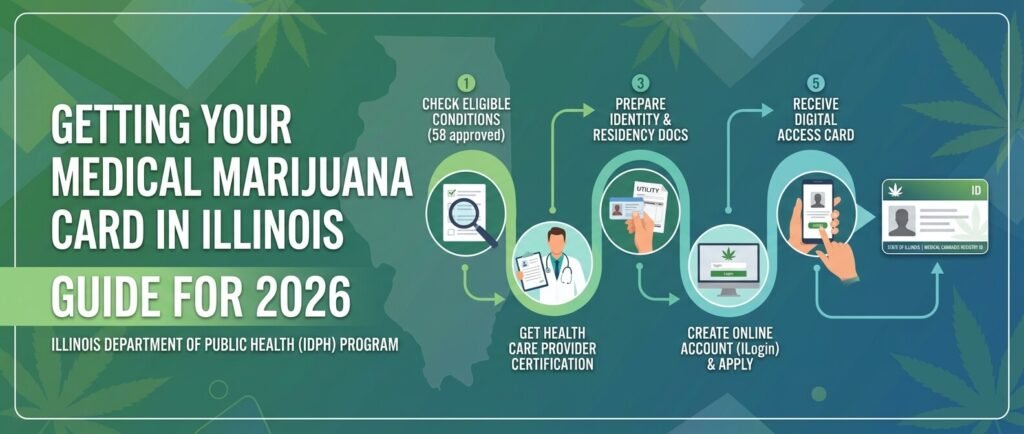
Getting a medical marijuana card in Illinois in 2026 involves several steps, but the process becomes much easier when you understand what the state actually requires. Illinois operates the Medical Cannabis Patient Program (MCPP) through the Illinois Department of Public Health (IDPH), and qualifying residents can apply for a medical cannabis registry identification card after meeting the program requirements. The process generally involves confirming that you have an eligible medical condition, obtaining certification from a qualifying health care professional, preparing identity and residency documentation, completing the state application, and paying the applicable registration fee.
Illinois has also continued updating its program, so relying on an old checklist can create unnecessary confusion. In August 2026, IDPH added sickle cell disease and polyendocrine metabolic ovarian syndrome with chronic pain to the approved list, bringing the total number of qualifying debilitating conditions to 58.
What the Illinois Medical Cannabis Card Does
An Illinois medical cannabis card is a state-issued registry identification card for patients who qualify for the Medical Cannabis Patient Program. It is not simply a doctor’s prescription, and the certification process is different from receiving an ordinary prescription medication. IDPH manages the registry and reviews applications from Illinois residents who meet the program’s requirements. Once an application becomes active, the patient can generate the cannabis card through the state patient account instead of waiting for a physical card to arrive in the mail. IDPH states that medical cannabis registration cards have been available through the patient’s online account for printing or downloading since June 2021.
That distinction matters when searching for information about a medical marijuana card Illinois residents can obtain in 2026. You may see different terminology online, including “medical cannabis card,” “medical marijuana card,” “registry card,” or “medical cannabis registry identification card.” These phrases can refer to the same general patient-access process, although medical cannabis is the terminology commonly used by Illinois state agencies. The card itself does not mean cannabis is appropriate for every medical condition, nor does it replace medical advice. Instead, it confirms that a qualifying patient has been registered with the state’s medical cannabis program. Once registered, the patient can use the card in accordance with Illinois medical cannabis laws and applicable purchase limits.
Who Can Qualify for a Medical Marijuana Card in Illinois
The first question most applicants should ask is simple: Does my medical condition qualify under Illinois law? Illinois maintains a specific list of debilitating medical conditions that can qualify a resident for the Medical Cannabis Patient Program. Having a general health problem does not automatically mean a patient qualifies, and an online claim that a particular symptom is enough should not be treated as official guidance. IDPH states that qualifying patients must have a debilitating condition as defined under the Compassionate Use of Medical Cannabis Pilot Program Act.
The qualifying-condition requirement is only one part of the process. A patient also needs the appropriate health care professional certification unless applying through a special pathway that has different requirements. The certification establishes the medical basis for participation in the program, while the state application establishes the patient’s identity, residency, registration information, and other required details. Think of the process as two connected pieces: the health care professional establishes the medical eligibility, while IDPH handles the state registration. Both pieces need to fit together before the application can become active.
Illinois’ 58 Qualifying Medical Conditions
As of the latest IDPH information available in 2026, Illinois recognizes 58 debilitating conditions for the Medical Cannabis Patient Program. The current list includes conditions such as cancer, chronic pain, Crohn’s disease, glaucoma, migraines, multiple sclerosis, neuropathy, Parkinson’s disease, PTSD, rheumatoid arthritis, seizures, severe fibromyalgia, traumatic brain injury, ulcerative colitis, and several other conditions. The list was expanded in August 2026 when IDPH approved sickle cell disease and polyendocrine metabolic ovarian syndrome with chronic pain, bringing the total to 58.
The complete current list includes:
- Autism
- Agitation of Alzheimer’s disease
- HIV/AIDS
- ALS
- Anorexia nervosa
- Arnold-Chiari malformation
- Cancer
- Cachexia/wasting syndrome
- Causalgia
- Chronic inflammatory demyelinating polyneuropathy
- Chronic pain
- Crohn’s disease
- CRPS Type II
- Dystonia
- Ehlers-Danlos syndrome
- Endometriosis
- Female orgasmic disorder
- Fibrous dysplasia
- Glaucoma
- Hepatitis C
- Hydrocephalus
- Hydromyelia
- Interstitial cystitis
- Irritable bowel syndrome
- Lupus
- Migraines
- Multiple sclerosis
- Muscular dystrophy
- Myasthenia gravis
- Myoclonus
- Nail-patella syndrome
- Neuro-Behçet’s autoimmune disease
- Neurofibromatosis
- Neuropathy
- Osteoarthritis
- Ovarian cysts
- Parkinson’s disease
- Polycystic kidney disease
- PMOS with chronic pain
- Post-concussion syndrome
- PTSD
- Reflex sympathetic dystrophy
- Residual limb pain
- Rheumatoid arthritis
- Seizures, including those characteristic of epilepsy
- Severe fibromyalgia
- Sickle cell disease
- Sjögren’s syndrome
- Spinal cord disease
- Spinal cord injury with the required neurological indication
- Spinocerebellar ataxia
- Superior canal dehiscence syndrome
- Syringomyelia
- Tarlov cysts
- Tourette syndrome
- Traumatic brain injury
- Ulcerative colitis
- Uterine fibroids
Because the list can change through the state’s petition and review process, applicants should check the current IDPH list before beginning an application. The August 2026 update is a good example of why older articles can become inaccurate: information published before that change may show only 56 qualifying conditions.
Illinois Residency and Patient Requirements
Illinois’ Medical Cannabis Patient Program is designed for qualifying Illinois residents. IDPH explains that the state manages the registry and issues registry cards to Illinois residents who meet the program requirements. Residency is therefore not a minor administrative detail. You need to be prepared to provide documentation supporting your Illinois residence during the application process.
The application also requires identity information and supporting documentation. The state portal provides specific instructions for uploading a passport-style photo and identification document, while proof of residence may be required when the address shown on your identification does not establish the necessary residency information. Accepted residency documents can include items such as utility bills, bank statements, leases, insurance policies, voter registration, a driver’s license or state ID, and other documents listed by IDPH.
Get a Health Care Provider Certification
After confirming that your condition appears on Illinois’ qualifying list, the next major step is obtaining certification from a qualifying health care professional. IDPH explains that a qualifying patient’s debilitating medical condition must be certified by an eligible health care professional. The state recognizes physicians as well as certain advanced practice nurses, advanced practice registered nurses with full practice authority, and physician assistants for certification purposes.
The certification is not the same thing as a cannabis prescription. IDPH specifically states that the online health care professional certification does not constitute a prescription for medical cannabis. The provider is certifying the patient’s qualifying medical condition within the state program. The certification is then associated with the patient’s application so IDPH can process the registry request. This is one reason applicants should work with a legitimate health care professional who has an appropriate provider-patient relationship rather than relying on websites promising an automatic card without proper medical review.
Who Can Certify an Illinois Patient
Illinois allows certain qualified health care professionals to certify patients for the Medical Cannabis Patient Program. According to IDPH, this includes an MD or DO, qualifying advanced practice nurses, APRN-FPAs, and physician assistants. The state also explains that a bona fide health care provider-patient relationship is required, and IDPH does not maintain or publish a list of individual practitioners who certify patients.
Applicants should therefore be careful with services that promise guaranteed approval, guaranteed eligibility, or a certification without appropriate medical assessment. The medical professional still has to determine whether certification is appropriate. IDPH says the health care provider certification is valid for 90 days from the date of the in-person medical examination for application purposes, which is an important detail for applicants planning the timing of their paperwork.
Prepare the Documents You Need
Gathering your documents before starting the application can make the process much smoother. The IDPH cannabis portal requires applicants to provide information and uploads associated with identity, residency, and the health care professional certification. A common mistake is starting the application first and discovering later that a required document is unavailable, expired, unclear, or inconsistent with the information entered in the application. Preparing everything in advance gives you a chance to resolve those issues before submission.
At a basic level, applicants should be prepared to provide an acceptable identification document, a suitable photo, Illinois residency evidence when required, personal information, and the certification information supplied by the health care professional. The exact documents can depend on the applicant’s circumstances and the route being used. IDPH’s official portal instructions should be treated as the final checklist rather than relying on a third-party website’s document list.
Identity and Proof of Illinois Residency
The identity section of the IDPH portal requires a valid photo or identification document. The state provides options such as a driver’s license, state ID card, passport, or another accepted identification document. Applicants also upload the required card photo through the portal. If the address on the identification document does not match the information being used for the application, IDPH may require additional proof of residence.
For proof of residence, IDPH lists several acceptable categories. Examples include a paystub or electronic deposit receipt, credit card statement, utility bill, bank statement, medical claim, benefits documentation, college or university tuition documentation, driver’s license or state ID, voter registration, deed, mortgage, rental agreement, property tax documentation, insurance policy, and certain military identification documents. Some documents must be recent, while others can be valid/current or from a specified period.
Create Your Illinois Cannabis Portal Account
The Illinois medical cannabis application is completed through the state’s online system. IDPH’s current instructions state that logging into the Cannabis Portal requires an ILogin account. Applicants who do not already have an ILogin account need to establish one before proceeding through the state portal. After logging in, the portal presents different program pathways, including adult patient registration, veteran registration, minor patient caregiver registration, and the Opioid Alternative Patient Program.
This online approach is one of the biggest practical differences between the current system and older descriptions of the Illinois program. The patient account is also where the digital cannabis card becomes available after approval. Because the account contains personal and medical-program information, applicants should use accurate information and protect their login credentials. If an application encounters a technical issue, applicants should use official IDPH support channels rather than creating duplicate accounts or submitting inconsistent applications.
Complete the Online Patient Application
For an adult patient application, the IDPH instructions direct applicants to select the Adult Medical Cannabis Patient section and complete the required fields. The portal uses checkboxes and mandatory fields to guide applicants through the registration process. After entering the patient information, the applicant proceeds to the health care professional certification portion of the application.
The certification number supplied by the health care professional is associated with the patient’s information in the system. IDPH explains that the certification is required before the application can be submitted. After that stage, the applicant continues through identity verification, residency documentation, and the remaining application requirements.
Accuracy matters throughout this process. A spelling difference, incorrect date of birth, inconsistent address, or missing document can create avoidable delays. Rather than rushing through the application, compare the information you enter against your identification and supporting records before submitting it.
Illinois Medical Cannabis Card Fees in 2026
The Illinois medical cannabis program has registration fees that vary depending on the type and duration of the application. For a regular patient, IDPH currently lists fees of $50 for one year, $100 for two years, and $125 for three years. These are the state registration fees and should be distinguished from any separate costs associated with obtaining medical care, documentation, photographs, or other services.
For applicants considering a medical marijuana card Illinois search in 2026, understanding the fee structure can prevent confusion when comparing different providers or websites. A third-party medical evaluation fee, if applicable, is not automatically the same thing as the state registration fee. IDPH also notes that qualifying patients do not need to pay a special fee to a health care provider specifically for the written certification, although the provider may charge for the required physical examination.
| Registration Type | 1 Year | 2 Years | 3 Years |
| Regular Patient | $50 | $100 | $125 |
| Reduced-Fee Patient | $25 | $50 | $75 |
| Minor Patient | $50 | $100 | $125 |
| Lifelong Renewal Patient | N/A | N/A | $50 |
| Designated Caregiver | $25 | $50 | $75 |
These fees reflect the current IDPH fee schedule and can change, so applicants should verify the amount shown by the state when submitting payment.
Reduced-Fee Applications
Illinois provides reduced-fee options for qualifying applicants. The current IDPH fee schedule lists the reduced-fee patient application at $25 for one year, $50 for two years, and $75 for three years. Eligibility for a reduced fee depends on the requirements established by the program, so applicants should review the official state instructions rather than assuming that everyone qualifies for the lower rate.
Caregiver arrangements can also change the total registration cost. IDPH publishes separate fees for designated caregivers and combinations involving one, two, or three caregivers. This makes it important to identify your application type before calculating the total amount. If cost is a concern, checking the state’s current fee page before submitting payment can help you avoid budgeting based on an outdated article.
Application Review and Getting Your Digital Card
After completing the required application steps and submitting payment, the application enters the state’s review process. The patient dashboard allows applicants to monitor the status of the application. IDPH explains that once an application is approved, the status changes to Active, and the patient receives notification that the medical cannabis card is available online or that corrections may be required.
Once the application status becomes Active, the patient can generate the cannabis card from the dashboard. IDPH states that the card can be generated from the View Registry ID Card section, allowing the patient to view, download, or print the digital card.
This digital-card system means you do not need to wait for a traditional plastic card to arrive in the mail. However, approval should not be confused with merely submitting an application. Your status needs to become active before the registry card is generated. If IDPH requests corrections, address those issues through the portal and follow the state’s instructions rather than assuming the application will automatically proceed.
Buying Medical Cannabis After Approval
Once your Illinois medical cannabis registration is active, you can use the registry card according to the state’s rules. Medical cannabis purchases are made through licensed dispensaries. Illinois has also changed how some dispensaries serve medical patients in 2026. In September 2026, the Illinois Department of Financial and Professional Regulation announced that 37 existing dispensaries received medical cannabis licenses and could serve both adult-use customers and medical patients at the same location.
For patients, this means access points can vary depending on location and licensing. Before visiting a dispensary, confirm that it serves registered medical patients and check its current requirements. Having your registry information available can make the process easier, but the state’s rules regarding purchases, possession, and product limits still apply.
Understanding the 14-Day Purchase Limit
Illinois generally establishes a medical cannabis purchase limit of 2.5 ounces during a 14-day period, commonly described as the patient’s adequate supply. IDPH’s provider guidance confirms the 2.5-ounce limit and explains that a health care provider can request an increased allotment through a waiver when the standard amount is insufficient for the patient’s qualifying condition.
The state has also clarified how different cannabis products count toward this limit. Illinois’ Cannabis Regulation Oversight Office explains that the typical patient limit is 2.5 ounces, or approximately 70.87 grams, and that flower, pre-rolls, concentrates, vapes, edibles, oils, and other cannabis products are counted under the applicable single purchase-limit calculation.
The key point is that patients should not assume the limit resets simply because they purchase a different product category. The state’s calculation takes previous purchases into account. Patients should follow the purchase records and limits shown through the regulated system and comply with Illinois possession and consumption laws.
The Opioid Alternative Patient Program
Illinois also operates the Opioid Alternative Patient Program (OAPP), which provides a separate pathway for certain qualifying residents. According to IDPH, the program allows individuals who have or could receive an opioid prescription for a qualifying medical condition to access medical cannabis under the program’s specific requirements. The OAPP is different from the standard Medical Cannabis Patient Program, so applicants should not automatically assume that the same eligibility criteria or fees apply.
The current IDPH information states that OAPP patients must be at least 21 years old and Illinois residents. A licensed Illinois physician must certify that the patient has a medical condition for which an opioid has been or could be prescribed based on generally accepted standards of care. The program permits registered patients to purchase 2.5 ounces every 14 days, and IDPH lists a $10 fee for each 90-day registration period.
For someone searching for an Illinois medical cannabis option because of pain or a condition potentially treated with opioids, the OAPP can therefore be an important pathway to understand. It should not be confused with the standard 58-condition MCPP list. Reviewing the official OAPP requirements can help determine which registration route applies to an individual’s circumstances.
Renewing Your Illinois Medical Cannabis Card
A medical cannabis registration card is not necessarily permanent. For regular patient registrations, Illinois offers one-, two-, and three-year terms, and the renewal process needs to be completed according to the applicable program requirements. IDPH explains that a patient’s account automatically changes to Pending Renewal within 90 days of the expiration date for the standard Medical Cannabis Patient Program.
When the application becomes eligible for renewal, the patient can use the renewal option in the account. The patient’s existing information may be carried forward, reducing the need to start completely from scratch. Veterans can also select the applicable veteran pathway when renewing, according to IDPH’s instructions.
Planning ahead is better than waiting until the final days before expiration. A certification, document, payment issue, or application correction can take additional time to resolve. Checking the dashboard before the registration expires gives you a clearer opportunity to handle the renewal process without an unnecessary interruption.
Common Application Mistakes to Avoid
Many problems with a medical marijuana card Illinois application are not complicated medical issues. They are administrative mistakes. Applicants sometimes upload unclear identification, use an address that does not match their supporting documents, forget the required certification, select the wrong program pathway, or rely on an old fee schedule. Because the IDPH system is document-driven, a small inconsistency can turn a straightforward application into a correction exercise.
Another common mistake is assuming that every online “medical card” website represents the state program itself. Private providers may offer medical evaluation or assistance, but the state registration is handled through Illinois’ official system. IDPH also explicitly says it does not maintain or publish a list of providers who issue health care professional certifications.
Before submitting your application, use a simple checklist:
- Confirm that your condition appears on the current IDPH qualifying list.
- Confirm that you meet the applicable Illinois residency requirements.
- Obtain the required health care professional certification.
- Create or access your ILogin account.
- Prepare your identification and photo.
- Prepare proof of Illinois residency if required.
- Check that your personal information is consistent across documents.
- Select the correct patient program.
- Review the current state registration fee.
- Submit the application and monitor your dashboard.
- Respond promptly if IDPH requests corrections.
- Wait for the application status to become Active before relying on the registry card.
Illinois also provides free application assistance through certain certified local health departments for qualifying patients. IDPH explains that this assistance can include help with new applications, renewals, and extensions, although applicants remain responsible for registration fees and other associated costs.
Conclusion
Getting a medical marijuana card in Illinois in 2026 is a structured process rather than a single appointment or form. Start by checking whether your medical condition appears on the state’s current list of qualifying debilitating conditions. Then work with an eligible health care professional for the required certification, prepare your identity and residency documentation, create your state portal account, complete the application, pay the applicable registration fee, and monitor the application until the status becomes Active. The current Illinois program recognizes 58 qualifying conditions, with sickle cell disease and PMOS with chronic pain added in August 2026, so checking the latest state information is especially important.
The state also provides several pathways and accommodations, including reduced-fee applications, veteran registration options, caregiver registration, and the separate Opioid Alternative Patient Program. Once approved, the registry card is available digitally through the patient account, and registered patients can purchase medical cannabis through licensed dispensaries within the applicable limits.
If you’re preparing an application now, the safest approach is to use the current Illinois Department of Public Health instructions as your final source of truth. Program rules, qualifying conditions, fees, and administrative procedures can change, and 2026 has already brought meaningful updates. A few minutes spent checking the current requirements can save much more time later.
FAQs
- How much does a medical marijuana card cost in Illinois in 2026?
For a regular Medical Cannabis Patient Program application, IDPH currently lists $50 for one year, $100 for two years, and $125 for three years. Reduced-fee applications are listed at $25, $50, and $75 respectively. These are state registration fees and do not necessarily include any separate costs associated with medical evaluation, required examinations, photographs, or other services.
- How many qualifying conditions are there in Illinois in 2026?
Illinois currently recognizes 58 debilitating medical conditions for the Medical Cannabis Patient Program. In August 2026, IDPH added sickle cell disease and polyendocrine metabolic ovarian syndrome with chronic pain, bringing the total to 58.
- Can I get an Illinois medical cannabis card completely online?
The state application is completed through an online portal, but medical eligibility still requires the appropriate health care professional certification under the standard program. IDPH’s guidance states that the certification is based on the required medical examination and that the certification is valid for 90 days for application purposes.
- How long is an Illinois medical cannabis card valid?
The standard MCPP offers registration terms of one, two, or three years, depending on the application selected and approved. IDPH also provides a renewal process, with the account moving into Pending Renewal within 90 days of expiration for the standard program.
- How much medical cannabis can an Illinois patient purchase?
The typical medical cannabis purchase limit is 2.5 ounces during a 14-day period. A health care provider can request an increased allotment through the appropriate waiver process when the standard amount is medically insufficient and the request is approved.