
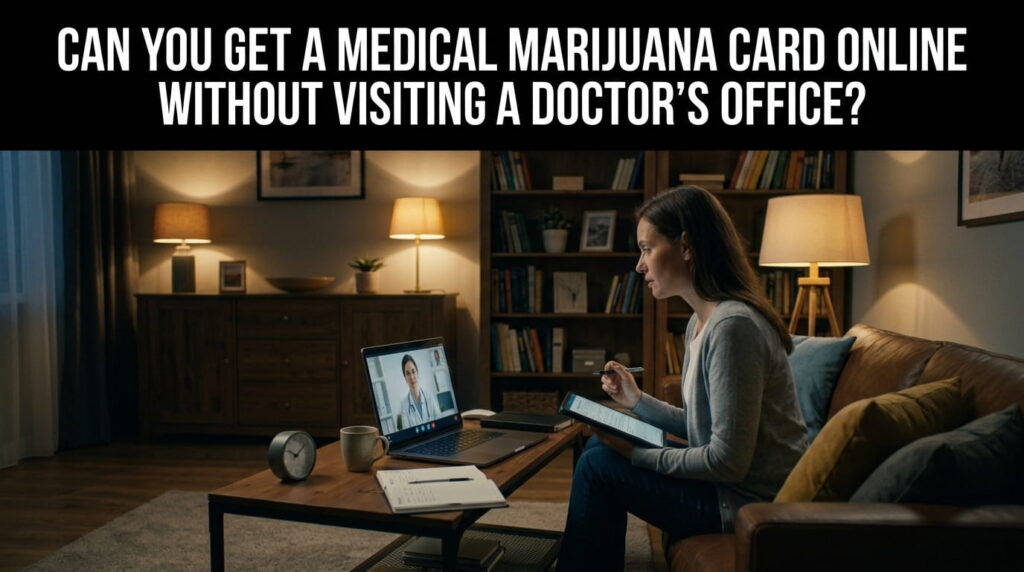
Yes, in some states, patients can complete the medical cannabis evaluation process online without physically visiting a doctor’s office, but there is an important catch: the rules are determined by the state where the patient is located, and they can change. An online service generally does not mean that you simply fill out a form and automatically receive a medical marijuana card. Instead, a licensed healthcare professional may evaluate you through a secure telehealth appointment, review your medical information, discuss your symptoms and health history, and determine whether you meet the state’s requirements for medical cannabis certification. Current state laws vary considerably, and the National Conference of State Legislatures maintains an updated database of state cannabis legislation, reflecting how frequently these rules evolve.
For someone searching for a medical marijuana card online, the biggest advantage is convenience. Instead of driving to a clinic, sitting in a waiting room, completing paperwork by hand, and rearranging your day around an appointment, an eligible patient may be able to complete much of the process from home. This can be especially useful for people with limited mobility, busy schedules, transportation difficulties, or who simply prefer virtual healthcare. However, online access should never be confused with bypassing medical or legal requirements. A legitimate online MMJ evaluation still involves a healthcare assessment, and some states require an in-person examination before certification. Alabama, for example, expressly prohibits telemedicine for certifying or recertifying patients for medical cannabis and requires the physician to be physically present with the patient.
What Is a Medical Marijuana Card?
A medical marijuana card, often called an MMJ card, medical cannabis card, or patient registry card, is generally connected to a state’s medical cannabis program. The exact system differs from one state to another, but the basic concept is similar: eligible patients receive authorization or certification that allows them to participate in the state’s regulated medical cannabis program under applicable state law. Depending on the state, a physician or another authorized healthcare professional may need to certify that the patient has a qualifying condition or otherwise meets the program’s eligibility requirements. The patient may then complete a state registration process, pay applicable fees, and receive a registry identification card or other proof of enrollment. NCSL’s current state-by-state resource shows that medical cannabis programs, qualifying conditions, registration systems, and related requirements differ across jurisdictions.
That distinction matters because an online medical marijuana card is not usually a completely separate type of card. The word “online” generally describes how part of the evaluation or application process is completed. Think of it as changing the route you take to reach the same destination rather than creating a different destination. A telehealth appointment may replace an office visit where permitted, while state registration and other requirements can still apply afterward. Patients should therefore look beyond marketing phrases such as “instant MMJ card” or “get approved online” and determine exactly what the service provides, which licensed professional conducts the evaluation, and whether the process complies with the patient’s state rules.
Medical Card vs. Recreational Cannabis Access
Medical cannabis and adult-use cannabis are related but legally distinct concepts, and confusing them can make the process unnecessarily complicated. Some states permit adult-use cannabis, meaning adults who satisfy the state’s age and other requirements may purchase cannabis without participating in a medical program. Other states operate medical-only programs, limited low-THC programs, or different combinations of medical and adult-use rules. NCSL’s September 2026 report identifies 41 states, three territories, and the District of Columbia as allowing medical cannabis use under its stated criteria as of June 26, 2025, while the regulatory landscape continues to change.
A medical marijuana card can still have practical importance even where adult-use cannabis exists. Medical programs may have different purchasing rules, qualifying criteria, possession limits, taxes, patient protections, or product access depending on the state. The exact benefits cannot be assumed nationally because cannabis law is largely state-specific. For that reason, a person searching for a telehealth medical marijuana card should first establish which program applies to them and then check the current rules of the relevant state agency. An online evaluation may make the healthcare portion easier, but it does not erase the distinction between medical authorization and recreational access.
Can You Get a Medical Marijuana Card Online?
In many jurisdictions, an online process can be available, but whether a patient can complete the entire medical certification without entering a doctor’s office depends on state law and the provider’s licensing requirements. Telehealth has become an established part of healthcare delivery, particularly because it can connect patients with healthcare professionals without requiring travel. The National Conference of State Legislatures describes telehealth as a potentially cost-effective approach for expanding healthcare access, particularly for rural and underserved populations.
For medical cannabis specifically, the online process usually revolves around a virtual evaluation rather than an automatic approval. A patient may submit basic information, schedule a telehealth appointment, speak with a licensed provider, and discuss their medical history and symptoms. If the provider determines that the patient meets the state’s requirements, the provider may submit or issue the appropriate certification, depending on that state’s system. The patient may then need to complete a separate registration with the state’s medical cannabis authority. This is why the phrase get MMJ card from home should be understood as a description of convenience, not a promise that every step will happen automatically online.
How Online MMJ Evaluations Work
An online MMJ evaluation generally begins with an eligibility or intake process. Patients may be asked for identification, proof of residency, medical information, current medications, relevant medical records, and details about the symptoms or condition they want to discuss. During the telehealth consultation, the healthcare professional can ask questions about the patient’s medical history and determine whether medical cannabis certification is appropriate under the applicable state program. The appointment may be conducted by secure video or another telehealth method allowed by the provider and state regulations.
The outcome depends on the healthcare professional’s assessment and the legal framework. A legitimate service cannot ethically or legally guarantee that every patient will qualify simply because they paid an evaluation fee. The provider needs to make an independent determination based on the information available and the rules that apply. Some states may also have additional requirements that cannot be completed through the private telehealth company alone. Patients should therefore treat the online evaluation as a healthcare appointment, not as a simple online purchase.
What Happens During a Telehealth Appointment?
A telehealth medical cannabis appointment is generally straightforward, but it should still be treated like a real medical consultation. The provider may ask why you are seeking medical cannabis, what symptoms or qualifying conditions you have, how long those symptoms have been present, what treatments you have tried, what medications you currently take, and whether there are other health factors that could affect the recommendation. You may also need to confirm your identity and physical location because healthcare providers generally must comply with applicable licensing and telehealth rules. Depending on the state and provider, medical records or other documentation may also be requested.
The goal is not simply to check boxes. The healthcare professional should have enough information to make an informed clinical decision within the scope of the state’s medical cannabis program. Telehealth rules themselves are also subject to changing federal and state requirements. For example, HHS states that certain federal telemedicine flexibilities for controlled medications have been extended through December 31, 2026, although medical cannabis certification operates within its own state-regulated framework and should not automatically be treated as identical to prescribing a federally controlled medication.
Is an In-Person Doctor Visit Required?
Not always. Whether an in-person appointment is necessary depends heavily on the state, the type of medical cannabis program, and the rules governing healthcare professionals who perform certifications. Some states permit telehealth evaluations, while others require an initial face-to-face examination or impose additional circumstances under which an in-person visit is mandatory. Alabama is a clear example of a state with a strict requirement: its medical licensing authority states that telemedicine cannot be used for certifying or recertifying a patient for medical cannabis, and the certifying physician must conduct a physical examination while physically present with the patient.
This state-by-state variation is one of the most important points to understand before searching for a medical marijuana card online. A website may advertise online evaluations nationally, but that does not necessarily mean every patient in every state can legally complete certification remotely. The provider must follow the laws of the jurisdiction where the patient is located and meet any licensing requirements. Patients should therefore verify the current state rules before paying for an appointment. Because cannabis legislation continues to evolve, relying on an old blog post or social media comment can be risky. NCSL’s cannabis policy database was updated September 14, 2026, illustrating how frequently current legislative information needs to be checked.
Why State Laws Matter for Online Medical Cannabis Evaluations
State law is the foundation of the entire medical cannabis process. There is no single nationwide rule saying that every American can obtain a medical marijuana card online in the same way. Each participating state establishes its own program requirements, including qualifying conditions, healthcare provider requirements, patient registration, possession limits, renewal rules, fees, and sometimes telehealth procedures. NCSL’s current state medical cannabis resource demonstrates the wide variation among states and tracks individual program structures.
That means a patient in one state could potentially complete a medical cannabis evaluation online, while another patient living elsewhere could be required to attend an office appointment. Even details such as whether a renewal can be performed through telehealth may differ from the rules for an initial certification. A responsible online provider should therefore ask where the patient is located before determining whether an appointment is appropriate. The safest approach is simple: identify your state, check its official medical cannabis program, and then confirm that the healthcare provider you choose is authorized to evaluate patients there.
Who May Qualify for an Online MMJ Evaluation?
Eligibility depends on the medical cannabis laws of the state where the patient is applying. Some states maintain lists of qualifying medical conditions, while others use broader standards that give authorized healthcare professionals more discretion. Age requirements, residency requirements, documentation rules, and physician certification standards can also vary. Because of this, there is no universal checklist that can guarantee eligibility for an online MMJ evaluation across the United States.
A good starting point is to understand whether your health situation falls within the applicable state program and whether you have documentation that can support your medical history. Depending on the jurisdiction, this might include medical records, a diagnosis, medication history, or other evidence requested by the evaluating professional. Patients should be honest during the appointment rather than trying to phrase symptoms in a particular way to obtain approval. A legitimate evaluation is a healthcare interaction, and accurate information gives the provider a better basis for determining whether certification is appropriate.
What You Need Before Applying for an Online Medical Marijuana Card
Preparing your information before a telehealth appointment can make the process much smoother. You may need a government-issued photo ID, proof of residency, your date of birth, medical history, information about current medications, and relevant medical records. Some state programs also require specific forms, physician certifications, or registration information. Requirements can change, so patients should check the current state program rather than assuming that a checklist found online several years ago is still accurate.
It is also useful to have a reliable internet connection and a private location where you can speak openly with the healthcare professional. Keep your medication list nearby and be prepared to describe your symptoms accurately, including how long you have experienced them and what treatments you have already tried. If the provider asks for medical records, having them ready can reduce delays. The more organized the consultation, the less likely the appointment is to become a paperwork scavenger hunt.
Step-by-Step: How to Get an MMJ Card From Home
The process of trying to get an MMJ card from home can often be broken into several practical stages, although the exact steps differ by state. First, confirm that your state operates a medical cannabis program and determine whether telehealth certification is permitted. Second, choose a legitimate healthcare provider that is authorized to conduct medical cannabis evaluations for patients in your state. Third, complete the provider’s intake forms and schedule your virtual appointment. During the appointment, discuss your medical history and symptoms honestly and answer the provider’s questions.
If the healthcare professional determines that you qualify, the next step may involve a state registration application. Some providers submit certification information directly to the state system, while others give patients instructions for completing their own registration. You may need to upload identification, proof of residency, a photograph, or other documents and pay a state fee. Once the state’s process is completed, the patient receives the relevant authorization or registry documentation according to that state’s rules. The important point is that the process has multiple moving parts, and “online” generally refers to telehealth and digital paperwork rather than eliminating the official state process.
How Long Does the Online Process Take?
The timeline varies considerably because there are usually two separate stages to consider: the healthcare evaluation and the state’s registration process. The telehealth consultation itself may be relatively quick if the patient has all required information available and the provider can make a determination during the appointment. The state registration portion can take longer depending on the state’s system, application volume, verification requirements, and whether the application is complete.
Some state programs provide digital documentation quickly, while others may involve additional processing or physical cards. Oregon, for example, currently publishes application processing information and states that complete applications received during a specified period were being mailed cards within 7 to 10 business days as of September 14, 2026. That illustrates why a provider’s claim about same-day evaluation should not automatically be interpreted as same-day receipt of a physical state-issued card. Before making plans around a deadline, confirm which part of the process the advertised timeline actually covers.
How Much Does an Online Medical Marijuana Card Cost?
There is no single national price for an online medical marijuana card. Patients may encounter separate charges for the healthcare evaluation, state registration, renewal, and other administrative services depending on the jurisdiction and provider. Private telehealth evaluation prices can vary substantially, while state fees are established by the relevant state program. Some services advertise promotional prices, but the cheapest headline number is not necessarily the total cost.
When comparing providers, look at the complete price rather than focusing only on the initial appointment fee. Ask whether the price includes the evaluation, certification submission, follow-up communication, renewal assistance, or state registration support. Also verify whether the state charges its own fee separately. A transparent provider should make those distinctions clear before payment. The goal is not simply to find the lowest price; it is to find a legitimate process that complies with applicable medical and state requirements.
Is an Online Medical Cannabis Evaluation Safe and Legitimate?
An online medical cannabis evaluation can be legitimate when it is conducted through a properly licensed healthcare professional using a telehealth process permitted by the applicable state. Telehealth itself is not inherently less legitimate than an office visit. It is simply a different method of delivering healthcare, and it has become an important way of improving access for people who have difficulty traveling or who live far from healthcare services. NCSL notes that telehealth can help address access issues, workforce shortages, and geographic barriers.
The risk comes from fraudulent or misleading services rather than from telehealth itself. A website that promises guaranteed approval without a medical evaluation, asks for unusual payment methods, refuses to identify the evaluating professional, or makes unrealistic legal claims should raise concerns. Patients should also be careful with sites that use vague language about “nationwide approval” without explaining state-specific requirements. A genuine healthcare service should be transparent about licensing, the evaluation process, privacy practices, pricing, and what happens after the consultation.
How to Recognize a Legitimate Telehealth Provider
A legitimate provider should make it reasonably easy to understand who is providing the healthcare service. Look for information about the medical professionals, the states in which they are licensed, the telehealth process, privacy protections, and the specific services included in the fee. The provider should also explain whether the evaluation is conducted by a physician, nurse practitioner, or another authorized professional under the relevant state rules. If a website refuses to explain who evaluates patients, that is a meaningful warning sign.
Another useful test is the provider’s attitude toward eligibility. Real healthcare professionals cannot honestly promise that every patient will be approved before an evaluation takes place. A legitimate provider should explain that certification depends on the patient’s medical circumstances and the requirements of the applicable state program. The website should also avoid suggesting that an online evaluation overrides state law. The best online services make the process clearer, not more mysterious.
What Happens After Your Online Evaluation?
After a successful online evaluation, the next step depends on the state’s medical cannabis system. In some states, the evaluating healthcare professional enters the certification directly into a state registry. In others, the patient may have to create an account, complete an application, upload documentation, and pay a state registration fee. The provider may give instructions for completing these steps, but the final authorization comes through the applicable state framework rather than simply from a private website.
Patients should carefully review any confirmation or registration information they receive. Check names, dates, identification details, and expiration dates for accuracy. Keep copies of important documents and understand when renewal is required. A digital certification or approval message should not automatically be assumed to mean that the patient can ignore the state’s separate registration requirements. When in doubt, consult the official state medical cannabis program.
Can You Renew a Medical Marijuana Card Online?
In some states, yes. Online renewal can be particularly convenient because an existing patient may already have medical records and prior certification information available. However, renewal requirements are not necessarily identical to initial certification requirements. Some states allow telehealth renewals, while others may require an in-person appointment at particular intervals or under specific circumstances.
This is another area where outdated information can cause problems. A provider may have offered online renewals under a previous set of rules, while the state may later change its requirements. Patients should verify the current renewal rules before scheduling an appointment. If an online provider says renewal is available, confirm that the provider is authorized in your state and that the telehealth method meets the state’s current requirements.
Common Reasons an Online MMJ Application May Be Delayed
Applications can be delayed for reasons that have nothing to do with the medical evaluation itself. Missing identification, incorrect residency information, incomplete forms, inconsistent names, expired documents, unclear medical records, or errors in a state application can all create problems. Patients sometimes assume that because the consultation happened online, the entire process must also be instant, but state registration systems may have their own processing times.
Another common issue is misunderstanding the difference between provider certification and state approval. A healthcare professional may complete their portion of the process successfully, while the patient still has additional state registration steps to complete. If the patient does not finish those steps, the application can remain incomplete. Before leaving the process, make sure you know whether there is anything else you must submit. A five-minute check of your application status can prevent a surprisingly long paperwork detour.
Medical Marijuana Card Online vs. Visiting a Local Clinic
| Factor | Online MMJ Evaluation | Traditional Clinic Visit |
| Travel | Usually no office travel for eligible patients | Requires travel to clinic |
| Appointment | Telehealth appointment | In-person appointment |
| Convenience | Can often be completed from home | Requires physical attendance |
| Eligibility | Depends on state telehealth rules | Depends on state medical cannabis rules |
| Medical Assessment | Conducted remotely when legally permitted | Conducted in person |
| State Registration | May still be required separately | May still be required separately |
| Availability | Depends on licensed telehealth providers | Depends on local clinics |
| Best For | Patients seeking convenience and remote access | Patients who require or prefer in-person care |
The biggest difference between the two options is the method of consultation, not necessarily the legal outcome. If your state permits a telehealth medical marijuana card evaluation, an online appointment can save time and eliminate unnecessary travel. If your state requires an in-person certification, however, choosing an online provider will not change that requirement. In that situation, the local clinic route remains necessary.
Online evaluations can be especially useful for people who have transportation challenges, live far from a participating clinic, or simply prefer virtual healthcare. In-person appointments may be more appropriate when a physical examination is required or when a healthcare professional determines that remote evaluation is insufficient. Neither approach is automatically better for every patient. The right choice is the one that is both medically appropriate and legally permitted where the patient lives.
Frequently Asked Questions About Getting an MMJ Card Online
1. Can I get a medical marijuana card completely online?
In some states, patients can complete the healthcare evaluation remotely through telehealth, but the exact process varies. Some states still require an in-person examination, while others permit online certification under specified conditions. Even when the medical evaluation is online, the patient may still have to complete a separate state registration process. Always verify the current requirements for your state before assuming that every step can be completed digitally.
2. Is an online MMJ evaluation the same as seeing a doctor in person?
An online evaluation can be a legitimate healthcare consultation when it is conducted by an appropriately licensed professional through a legally permitted telehealth process. The difference is primarily the method of communication. The provider can still review your medical history, discuss symptoms, ask questions, and determine whether certification is appropriate. However, telehealth cannot replace an in-person examination when the applicable state law requires one.
3. Can I get an MMJ card from home without medical records?
That depends on the provider and state program. Some patients may be able to complete an evaluation based on their medical history and the information discussed during the consultation, while others may need supporting documentation. You should not fabricate or exaggerate medical information simply to satisfy an eligibility requirement. If records are requested, provide accurate documentation or ask the provider what alternatives are accepted.
4. How do I know if an online medical cannabis service is legitimate?
Check whether the provider identifies its healthcare professionals, explains their licensing, clearly describes the evaluation process, provides transparent pricing, and follows state-specific rules. Be cautious of services that guarantee approval before an evaluation or claim that their process works regardless of where you live. You can also verify requirements through your state’s official medical cannabis authority. A legitimate provider should make compliance easier to understand rather than asking patients to take legal shortcuts.
5. Are online medical marijuana card rules the same in every state?
No. State medical cannabis programs vary widely, and telehealth requirements can differ as well. NCSL’s current state cannabis resources show that medical cannabis legislation and program structures continue to evolve. For that reason, information that is accurate for one state may be completely wrong for another. Always check the rules that apply to your location before beginning the process.
Conclusion
So, can you get a medical marijuana card online without visiting a doctor’s office? In many places, the answer can be yes, but it is never a universal yes. The availability of an online medical marijuana card process depends on state law, the patient’s eligibility, the licensing of the healthcare professional, and the specific requirements of the state’s medical cannabis program. Where telehealth is permitted, an online medical cannabis evaluation can make the process considerably more convenient by allowing an eligible patient to speak with a healthcare professional from home rather than traveling to a clinic.
The smartest approach is to separate convenience from compliance. Search for a legitimate provider, confirm that telehealth evaluations are permitted in your state, understand the total cost, prepare your medical information, complete the evaluation honestly, and follow the state’s registration instructions afterward. Do not rely solely on claims such as “same-day card,” “guaranteed approval,” or “no doctor required,” because those phrases can hide important legal and medical details. State cannabis policies continue to change, with NCSL maintaining an updated database of enacted cannabis legislation, so checking current information is essential.
For eligible patients, the ability to get an MMJ card from home can turn a complicated process into a much simpler one. But the convenience should sit on top of a legitimate medical evaluation, not replace it. When the process is handled correctly, telehealth can provide a practical bridge between patients and qualified healthcare professionals while still respecting state medical cannabis requirements. The key is simple: online does not mean skipping the rules; it means accessing the right part of the process remotely when the law allows it.