
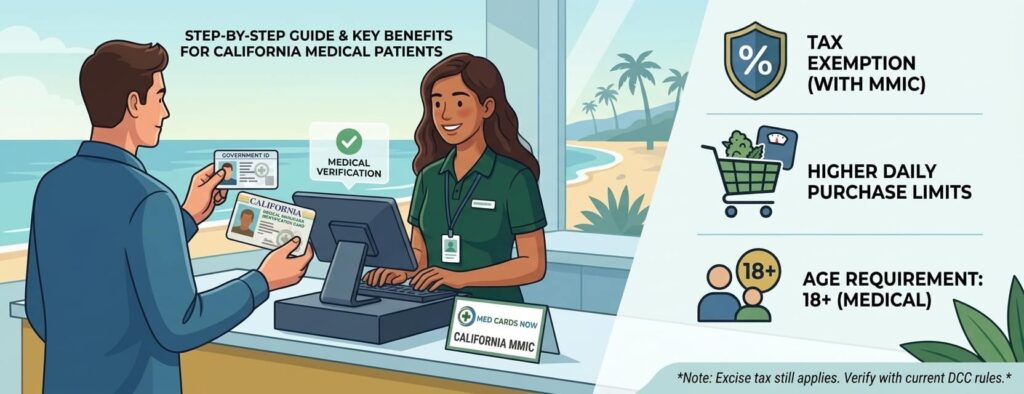
If you have recently received a California medical marijuana card or a physician’s recommendation, your first dispensary visit may feel unfamiliar. California allows adults 21 and older to purchase cannabis for adult use, while medicinal patients can purchase cannabis beginning at age 18 when they have a valid physician’s recommendation or medical marijuana identification card. That means having medical status can still matter, even though recreational cannabis is legal throughout the state.
The important part is knowing what your medical marijuana card in California actually does, which documents you need, how dispensary verification works, and which benefits apply specifically to medical patients. There is also an important distinction between a physician’s recommendation and the state-issued Medical Marijuana Identification Card (MMIC). These are not necessarily interchangeable when it comes to tax exemptions, so understanding the difference can save you confusion at checkout.
This guide from Med Cards Now walks through the process in clear, simple language. It also updates some commonly repeated information about California medical cannabis laws, including current purchase limits, taxation, identification requirements, licensed dispensaries, transportation rules, and the difference between medical recommendations and the state MMIC.
Why a California Medical Marijuana Card Still Matters
California was the first U.S. state to legalize medical cannabis when voters approved the Compassionate Use Act in 1996. Adult-use cannabis was later legalized, so it is reasonable for people to ask why they should bother obtaining a California medical marijuana card when an adult who is at least 21 can already purchase cannabis. The answer is that California maintains separate rules for medicinal and adult-use customers, and medical patients can receive benefits that adult-use customers do not automatically receive. The California Department of Cannabis Control confirms that medicinal customers can purchase cannabis from age 18 with a physician’s recommendation and that medicinal users have different possession, purchasing, and cultivation rules.
For someone who qualifies medically, the distinction can be particularly useful when purchasing cannabis regularly. A medical recommendation establishes medicinal eligibility, while a valid state-issued MMIC can provide a sales and use tax exemption on qualifying medicinal cannabis purchases when the patient also presents valid government-issued identification. The exemption is not simply created by having any online medical card or physician recommendation. California’s tax agency specifically says that the purchaser must provide both a valid CDPH-issued MMIC and valid government-issued ID to claim the exemption.
Medical Cannabis vs. Adult-Use Cannabis
The basic age distinction is straightforward. A California adult-use customer generally must be 21 or older, while a medicinal patient can purchase at 18 or older with a physician’s recommendation. Licensed retailers are required to verify customer age and identity before completing a sale. Acceptable identification includes government-issued photo identification such as a driver’s license, military ID, or passport.
The distinction becomes more meaningful when you look at medical purchase limits and tax treatment. California regulations provide medicinal patients with a daily limit of up to 8 ounces of dried mature cannabis flower, along with up to 12 immature cannabis plants, subject to the applicable medical recommendation and rules. The adult-use limits are substantially different, with the regulations specifying 28.5 grams of non-concentrated cannabis, 8 grams of concentrate, and six immature plants per day.
That does not mean every medical patient should purchase the maximum amount. Your actual needs, physician recommendation, local rules, product type, and dispensary policies all matter. The point is that California law recognizes medicinal customers separately from adult-use consumers, and your medical cannabis card can be part of that legal framework.
Key Benefits for California Medical Patients
The most commonly discussed benefit is tax treatment, but it is important to explain this accurately. A valid CDPH-issued MMIC can qualify a patient for an exemption from California sales and use tax on qualifying medicinal cannabis and medicinal cannabis products when the patient presents the MMIC and valid government-issued ID at the time of purchase. This does not mean every cannabis-related tax disappears. California’s cannabis excise tax is separate from sales and use tax, and the MMIC sales-tax exemption does not eliminate that cannabis excise tax.
California’s cannabis excise tax rate is currently 15% for retail sales occurring on or after October 1, 2025, according to the California Department of Tax and Fee Administration. Local taxes can also apply depending on the location, so the final amount on a receipt can vary between dispensaries and cities.
Medical patients can also have different possession and purchasing rules. The state regulations specify up to eight ounces of medicinal dried mature flower per day, while a physician’s recommendation can document a different amount based on the patient’s needs, subject to California law.
What You Need Before Visiting a California Dispensary
A smooth dispensary visit starts before you leave home. Think of the process like going through a security checkpoint: having the correct documents ready means you spend less time sorting things out at the front desk. At minimum, you should have a valid government-issued photo ID, and if you are purchasing as a medical patient, you should have the appropriate medical documentation available. Licensed retailers are required to verify age and identity before selling cannabis.
If you are specifically trying to receive the California sales and use tax exemption for medicinal cannabis, there is an additional requirement that is easy to miss. The California Department of Tax and Fee Administration states that the customer must present a valid Medical Marijuana Identification Card issued by CDPH plus valid government-issued identification at the time of purchase. A physician recommendation by itself does not provide that particular sales-tax exemption.
Physician Recommendation vs. MMIC
This is one of the most important distinctions for anyone searching for a medical marijuana card California patients can use at dispensaries. A physician’s recommendation is medical authorization from a licensed physician. The MMIC, on the other hand, is a state-authorized identification card issued through California’s Medical Marijuana Identification Card Program. CDPH explains that the MMIC identifies a qualified patient and can be verified through its system.
Why does this distinction matter? Because people sometimes use the words “medical card,” “medical recommendation,” and “MMIC” as if they are identical. They are not. A medical recommendation can establish medicinal eligibility for purchasing cannabis, but the specific California sales-tax exemption requires the valid state-issued MMIC and valid government ID.
| Medical Documentation | Main Purpose | Sales Tax Exemption? |
| Physician’s medical cannabis recommendation | Establishes medicinal eligibility | No, not by itself |
| California MMIC | State medical cannabis identification | Yes, when valid MMIC + government ID are presented |
| Government-issued photo ID | Confirms identity and age | Required for verification, but not a medical authorization by itself |
This is an important correction to a common misconception. Getting an online medical marijuana recommendation does not automatically mean that every cannabis purchase will be free from every tax. The exact benefit depends on the documentation you hold and the type of tax being charged.
Identification and Proof of Eligibility
Bring a valid government-issued photo ID every time you visit a dispensary. The California Department of Cannabis Control lists government-issued identification such as a driver’s license, military photo ID, or passport as acceptable examples. Retailers must verify your age before completing the transaction.
If you have an MMIC and want to claim the sales-tax exemption, make sure the card is valid and bring your government-issued ID as well. California’s tax guidance specifically requires both documents for the exemption.
It is also sensible to check the dispensary’s website before leaving home. Some retailers publish their menus, accepted payment methods, operating hours, and medical-patient policies online. Local cities and counties can also impose additional cannabis business restrictions, so rules can differ depending on where the dispensary operates.
Step-by-Step Guide to Using Your Medical Marijuana Card
Your first California dispensary visit does not need to be complicated. Once you understand the basic process, it becomes much more predictable. You arrive with your identification and medical documentation, complete verification, browse products, speak with dispensary staff if needed, pay for your purchase, and leave with properly packaged cannabis. Licensed retailers operate under state regulations designed to verify customers and ensure that cannabis products meet testing and labeling requirements.
1) Find a Licensed California Dispensary
Start by finding a licensed cannabis dispensary rather than assuming that every storefront advertising cannabis is legal. California’s Department of Cannabis Control warns that some businesses may look legitimate while operating without a license. Licensed retailers must meet regulatory requirements, and legal cannabis products are subject to testing and labeling standards.
The state recommends using its official resources to find licensed retailers. You can also check whether a retailer displays its state license and verify the license information before purchasing. This matters because buying from an unlicensed source can expose you to products that have not gone through the regulated testing process.
2) Bring the Correct Documents
Before entering the dispensary, make sure you have your ID and medical documentation. If you are 18 to 20 years old and purchasing medicinal cannabis, your physician’s recommendation or medical identification is particularly important because adult-use purchasing is restricted to customers 21 and older.
If you have a valid MMIC, bring it with your government-issued ID. If your goal is to claim the sales and use tax exemption, tell the dispensary staff that you are a medical patient and present the required documents before the transaction is finalized. California’s tax guidance says the qualifying documents must be provided at the time of purchase.
3) Complete Age and Patient Verification
When you enter a licensed dispensary, you may first encounter a reception or verification area. The staff will check your identification and determine whether you are purchasing as an adult-use customer or medicinal customer. This is a normal part of the process because retailers have legal obligations to verify customer identity and age.
If your information is valid, you can proceed to the retail area. Depending on the dispensary, the experience may feel more like a specialty store than a traditional pharmacy. Staff can explain products, formats, cannabinoid information, serving sizes, and labeling, but their role is not a substitute for medical advice from your healthcare professional.
4) Talk With the Dispensary Staff
If you are new to cannabis products, do not be afraid to ask questions. A licensed dispensary may have staff who can explain the difference between flower, pre-rolls, edibles, tinctures, topicals, concentrates, and other products that may be available. California requires regulated cannabis products to undergo testing and quality assurance procedures, and labels are designed to provide information about the product.
Keep your questions practical. You can ask about THC and CBD amounts, serving sizes, product formats, ingredients, and package information. If you are using cannabis for a medical purpose, your physician or qualified healthcare professional should remain your primary source for individualized medical guidance, particularly if you take prescription medicines or have an underlying health condition.
Understanding Medical Cannabis Taxes in California
Tax questions cause a surprising amount of confusion at California dispensaries. People often hear that medical patients are “tax free” and assume that presenting any medical card eliminates the entire tax bill. That is not accurate. California provides a sales and use tax exemption for qualifying medicinal cannabis purchases when the customer presents a valid CDPH-issued MMIC and valid government-issued identification, but the cannabis excise tax is separate.
The current California cannabis excise tax is 15% on retail sales made on or after October 1, 2025. Local cannabis business taxes can also vary from one jurisdiction to another. That means two dispensaries can potentially show different final totals even when the product price is similar.
How the MMIC Sales Tax Exemption Works
To claim the California sales-tax exemption, you need two things at checkout: a valid Medical Marijuana Identification Card issued by CDPH and a valid government-issued identification card. The retailer verifies the MMIC and maintains the information required for the exempt transaction.
The exemption applies to qualifying medicinal cannabis and medicinal cannabis products. It does not mean every product or every tax on a dispensary receipt automatically disappears. The cannabis excise tax remains separate, and local rules can affect the final transaction.
So, if someone tells you, “I have a medical recommendation, so I never pay cannabis taxes,” treat that statement carefully. The accurate answer depends on which document you have and which tax is being discussed.
California Medical Cannabis Purchase and Possession Limits
California provides different limits for medicinal and adult-use customers. Under current DCC regulations, an adult-use customer may purchase up to 28.5 grams of non-concentrated cannabis, 8 grams of concentrate, and six immature plants in a single day. Medicinal patients have a separate daily limit of up to 8 ounces of dried mature medicinal cannabis, along with up to 12 immature cannabis plants.
There is an additional detail that is particularly important for medical patients. The regulations state that if a valid physician’s recommendation documents a different amount, the medicinal patient may purchase an amount consistent with the patient’s medical needs as documented in that recommendation, subject to the applicable law and regulations.
Daily Medical Cannabis Limits
Do not confuse a possession or purchasing limit with a recommendation to consume a particular amount. These rules establish legal limits, not medical dosage instructions. Your healthcare professional should determine whether cannabis is appropriate for your circumstances and discuss individualized use where appropriate.
California also distinguishes medicinal cannabis from adult-use cannabis for home cultivation. State guidance says medicinal users may have higher cultivation allowances when their physician recommends it, while ordinary adult-use home cultivation is subject to its own rules and local restrictions.
Because cannabis regulations can change, it is smart to check the current California Department of Cannabis Control rules rather than relying on an old social media post or an article written several years ago. The DCC states that its current regulations were updated July 1, 2026.
What to Expect When Buying Medical Cannabis
Once your documents have been verified, you can browse the products available at the dispensary. Depending on the retailer, the menu may include flower, pre-rolls, edibles, concentrates, topicals, and other regulated cannabis goods. California requires cannabis sold by licensed retailers to meet testing and labeling requirements, which gives consumers more information about what they are purchasing.
A useful habit is to read the label instead of relying only on product names. Look for the amount of THC and CBD, serving information where applicable, ingredients, package information, and other required details. If you are unsure about a product, ask the dispensary staff to explain the label in plain language.
Product Selection and Labels
Different cannabis formats can have very different characteristics. Flower is generally inhaled, while edibles are consumed and can take longer to produce effects. Topical products are applied to the skin, while concentrates can contain substantially higher cannabinoid concentrations. Because these differences matter, new patients should avoid treating every product as though it works in the same way.
The safest approach is to start with information rather than assumptions. Discuss medical questions with your healthcare professional and ask dispensary staff about the product’s labeled contents. If you are taking other medications, have a medical condition, are pregnant or breastfeeding, or have concerns about possible interactions, speak with a qualified healthcare professional before using cannabis.
Payment, Packaging and Leaving the Dispensary
Payment policies vary between dispensaries, so check before visiting. Some retailers may accept cash, while others may offer approved electronic payment options. It is better to know the payment policy before you arrive than to discover at checkout that your preferred method is unavailable.
After purchase, keep the cannabis in its original packaging and follow the retailer’s instructions. California has strict rules about where cannabis can be consumed and how it may be transported. The state says cannabis cannot be used in public places and that open cannabis containers in vehicles are illegal. If cannabis is transported in a vehicle, it must be in a sealed package or container or stored in the trunk.
Important California Cannabis Rules After Your Purchase
Getting through the dispensary checkout does not end your legal responsibilities. California permits cannabis use under specific conditions, but there are still places where consumption is prohibited. The DCC states that cannabis may be used on private property, while public consumption is generally prohibited. Property owners can also prohibit cannabis use on their property.
Driving is another major consideration. California law prohibits driving under the influence of cannabis, and having an open cannabis container in a vehicle is illegal. The DCC specifically advises that cannabis in a vehicle must remain in a sealed package or container or be stored in the trunk.
You should also remember that California legalization does not override federal law. The DCC states that cannabis remains illegal under federal law and cannot be possessed or used on federal lands such as national parks or transported across state lines. A California medical marijuana card does not turn cannabis into a federally legal substance.
Cannabis Use, Transportation and Public Consumption
A medical recommendation gives you certain protections under California’s medical cannabis framework, but it does not provide permission to consume cannabis anywhere you want. Restaurants, bars, public spaces, many workplaces, federal properties, and other locations can have restrictions. Hotels and rental properties may also have their own rules.
The simplest rule is to think about where you are, who owns the property, and whether cannabis use is legally permitted there. If you are traveling, check local rules before assuming that a rule from one California city applies everywhere else. Cities and counties can impose additional restrictions on cannabis businesses and related activities.
Common Mistakes Medical Cannabis Patients Should Avoid
One of the biggest mistakes is assuming that an online physician recommendation automatically equals a state MMIC. These documents serve different purposes. If your goal is specifically to claim California’s medical cannabis sales-tax exemption, the state’s tax agency requires a valid CDPH-issued MMIC plus valid government-issued identification.
Another common mistake is buying from an unlicensed retailer simply because the storefront looks professional. The DCC warns that some businesses may appear legitimate while operating without a license. Licensed retailers provide regulated products that are subject to testing and labeling requirements, so checking licensing status is an important part of being an informed consumer.
Patients should also avoid relying on outdated information about cannabis taxes and limits. California’s cannabis regulations and tax rules can change, and the current excise tax rate is different from rates that appeared in older articles. For example, the cannabis excise tax changed to 15% for retail sales beginning October 1, 2025.
Finally, do not assume that a medical card allows cannabis across state lines or onto federal property. California’s state legalization framework does not override federal cannabis restrictions.
How to Get a California Medical Marijuana Card Online
For people who qualify medically, obtaining a California medical marijuana card online can be a convenient way to begin the medical recommendation process. Med Cards Now provides an online California medical marijuana evaluation process, with the site currently advertising a $37 California medical marijuana card service and an online process that includes a medical evaluation by a licensed cannabis physician.
The process is designed to be straightforward. You complete the required information, provide identity details, participate in the medical evaluation, and receive the recommendation if the evaluating physician determines that you qualify. Med Cards Now describes its California process as online and says approved patients can receive their medical recommendation electronically.
If you are considering applying, remember that an online recommendation is not the same thing as the California state-issued MMIC. That distinction is particularly important if you want to understand the medical sales-tax exemption. The state tax exemption is tied to the CDPH-issued MMIC and valid government-issued identification, not simply any document described as a “medical card.”
You can learn more about the California medical marijuana card process through Med Cards Now and review the current requirements before starting an evaluation.
Conclusion
Using a medical marijuana card at a California dispensary is relatively straightforward once you understand the difference between a physician’s recommendation, a California MMIC, and ordinary adult-use eligibility. Medical patients can purchase cannabis beginning at age 18 with a physician’s recommendation, while adult-use customers generally must be 21 or older. Medical patients can also have different purchase and possession rules, including a state-regulated daily medicinal limit of up to eight ounces of dried mature flower, subject to the applicable recommendation and law.
The biggest detail to remember is the tax distinction. A valid CDPH-issued Medical Marijuana Identification Card, together with valid government-issued identification, can qualify a patient for California’s sales and use tax exemption on qualifying medicinal cannabis purchases. However, the exemption does not eliminate the separate cannabis excise tax, which is currently 15% for retail sales beginning October 1, 2025.
Before visiting a dispensary, bring the right documents, verify that the retailer is licensed, understand the product labels, and check current local rules. After purchasing, follow California’s rules concerning consumption, transportation, and federal property. Cannabis laws can change, so checking current information from California’s Department of Cannabis Control and Department of Public Health is a smart habit.
If you are ready to explore the California medical marijuana card online process, Med Cards Now provides an online evaluation option designed to make the process simple and accessible. Always remember that eligibility is determined through the appropriate medical evaluation and that a medical cannabis recommendation does not replace advice from your healthcare professional.
Frequently Asked Questions
1. Can I use a California medical marijuana card at any dispensary?
You can purchase medicinal cannabis from a licensed California cannabis retailer when you meet the state’s requirements. Licensed retailers must verify customer age and identity. Because local cannabis rules can vary, it is a good idea to confirm that the dispensary is licensed and currently operating under applicable local rules before visiting.
2. Do I need an MMIC to buy medical cannabis in California?
Not necessarily. California allows medicinal patients age 18 or older to purchase cannabis with a physician’s recommendation. However, if you want to claim the specific California sales and use tax exemption for qualifying medicinal cannabis purchases, the CDTFA requires a valid CDPH-issued MMIC and valid government-issued identification.
3. Does a medical marijuana card make cannabis completely tax-free?
No. This is one of the most important misconceptions to avoid. A valid MMIC can qualify an eligible patient for the California sales and use tax exemption on qualifying medicinal cannabis purchases, but it does not eliminate the separate cannabis excise tax. California’s current cannabis excise tax rate is 15% for retail sales made on or after October 1, 2025, and local taxes can also apply.
4. How much medical cannabis can I purchase in California?
California regulations provide a medicinal daily limit of up to 8 ounces of dried mature cannabis and up to 12 immature cannabis plants. A valid physician’s recommendation may document a different amount consistent with the patient’s medical needs, subject to California law and regulations. These are legal limits, not recommendations for how much an individual should consume.
5. Can I take medical cannabis across state lines?
No. A California medical marijuana card does not authorize you to transport cannabis across state lines. The California Department of Cannabis Control states that cannabis remains illegal under federal law and that cannabis cannot be taken across state lines.